
Ethereum processes over $10 billion in daily transactions – but when two strangers need to exchange value safely, the blockchain alone isn’t enough. You need a mechanism that locks funds until both parties deliver. You need escrow.
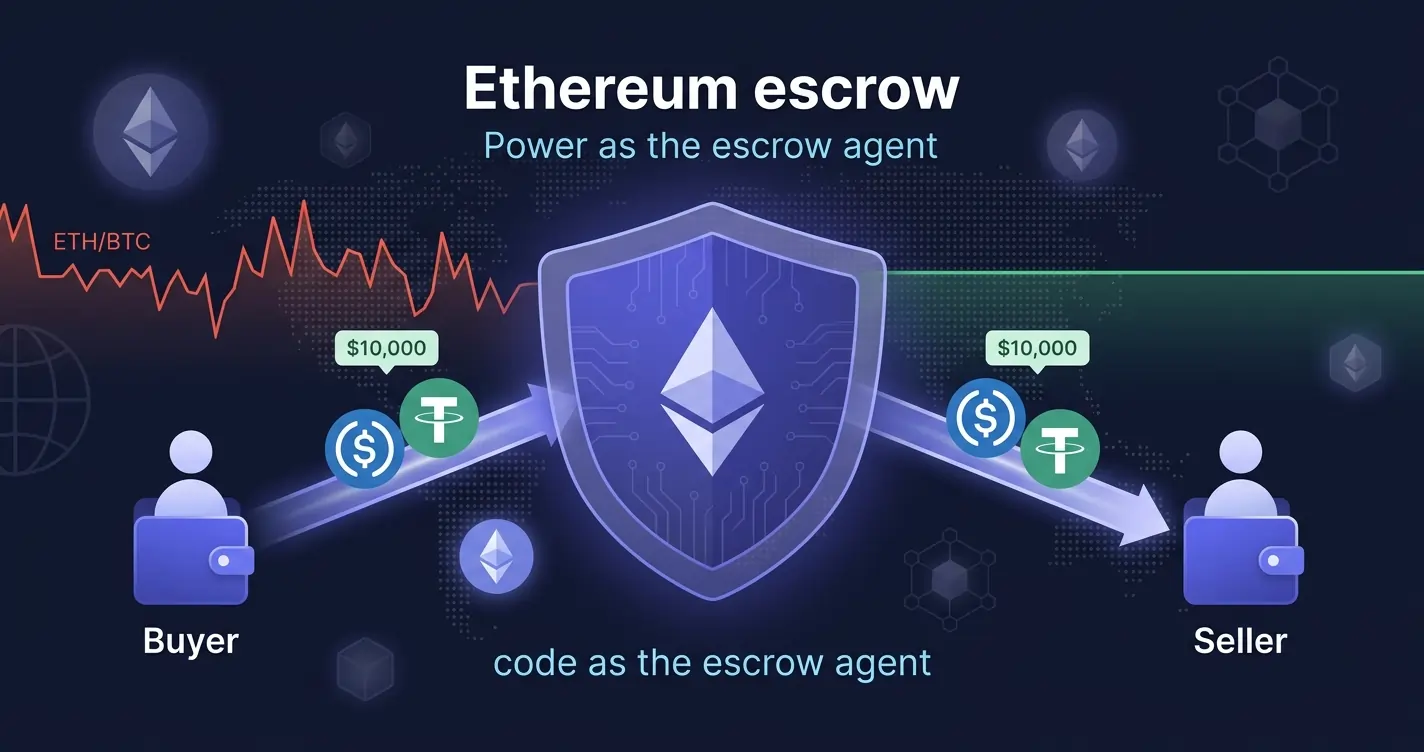
The problem? Most people think of escrow in terms of Bitcoin or fiat, where a trusted third party holds the money. But Ethereum changed the game entirely. With smart contracts, the code itself becomes the escrow agent – no humans, no custodians, no single point of failure.
There’s just one catch: if you’re using ETH or BTC for escrow, price volatility can turn a fair deal into a losing one before the transaction even completes. That’s why the future of Ethereum escrow services isn’t ETH itself – it’s stablecoins.
In this guide, we’ll explore why Ethereum is the best blockchain for escrow, how stablecoins solve the volatility problem, and what to look for when choosing an Ethereum escrow service in 2026.
Table of Contents
- Why Ethereum for Escrow?
- The Volatility Problem with Crypto Escrow
- Why Stablecoins Win for Escrow
- Comparing Ethereum Escrow Options
- Is Ethereum Code Safe?
- USDT vs USDC for Escrow
- How Zenland Uses Ethereum Stablecoins
- FAQ
Why Ethereum for Escrow?
Not all blockchains are created equal when it comes to escrow. Bitcoin has no native smart contracts. Solana is fast but has had multiple outages. Newer chains lack the tooling and liquidity. Ethereum remains the gold standard for escrow smart contracts – and here’s why.
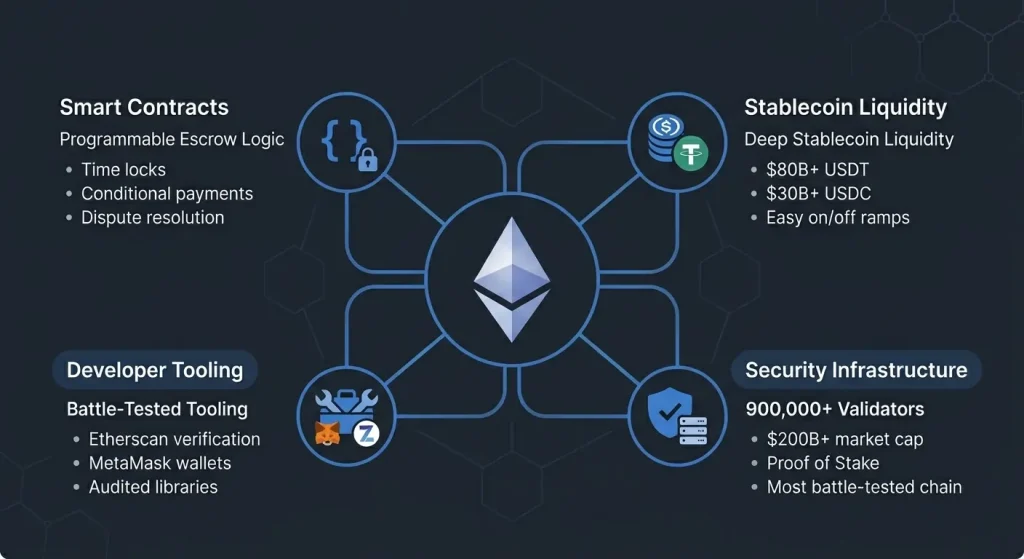
Smart Contract Capabilities
Ethereum was the first blockchain to support Turing-complete smart contracts – programs that can encode complex logic like conditional payments, time locks, multi-party approvals, and dispute resolution. This is exactly what escrow requires.
An Ethereum escrow smart contract can enforce rules like:
- Funds are locked until the buyer confirms delivery
- The seller can always issue a refund (no permanent lockups)
- If the buyer doesn’t respond within a protection period, the seller can claim
- A staked third-party agent can resolve disputes with a percentage-based split
Try doing that with a Bitcoin multisig wallet. You can’t – because Bitcoin’s scripting language doesn’t support this level of logic.
Network Security
Ethereum is the most battle-tested smart contract platform in existence. With over 900,000 validators securing the network and a market cap exceeding $200 billion, it’s the blockchain that institutions, DeFi protocols, and escrow platforms trust with real money.
When you lock $50,000 in an escrow contract, you want it on the chain with the deepest security – not the newest, fastest, or cheapest one. Security isn’t where you cut corners.
Ecosystem and Liquidity
Ethereum hosts the deepest stablecoin liquidity in crypto. Over $80 billion in USDT and $30 billion in USDC circulate on Ethereum and its Layer 2s. This matters for escrow because:
- Easy on-ramps – Every major exchange supports Ethereum stablecoin withdrawals
- Easy off-ramps – Convert stablecoins back to fiat on any exchange
- Tooling – Etherscan for verification, MetaMask for wallets, OpenZeppelin for audited contract libraries
- Composability – Escrow contracts can integrate with DeFi, DAOs, and other protocols
The ecosystem effect is real: more developers, more auditors, more users, and more liquidity all make Ethereum the safest choice for eth escrow services.
The Volatility Problem with Crypto Escrow
Here’s a scenario that plays out constantly in crypto escrow:
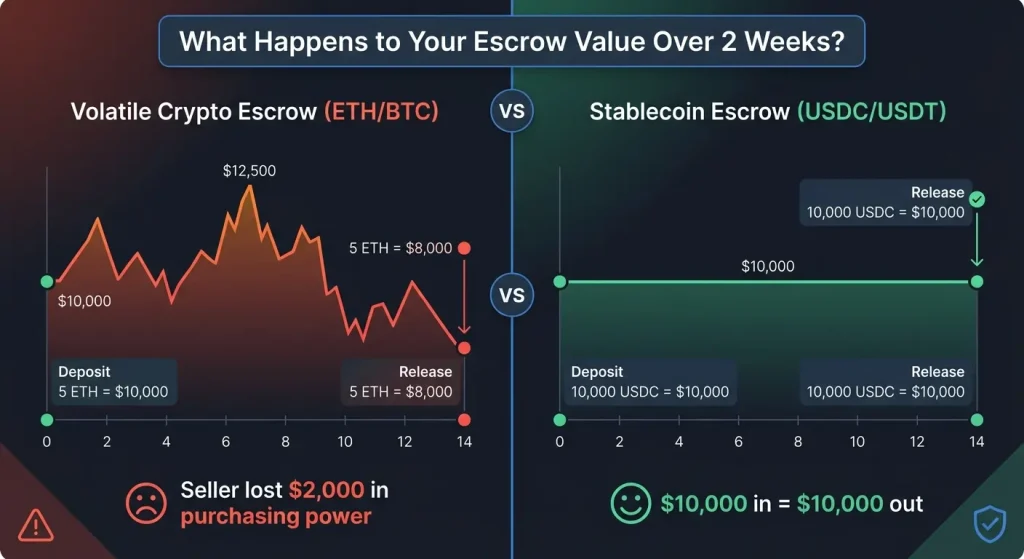
Alice hires Bob to build a website for 5 ETH. At the time of the agreement, ETH is trading at $2,000 – so the deal is worth $10,000. Alice deposits 5 ETH into escrow. Bob starts working.
Two weeks later, Bob delivers the website. But ETH has dropped to $1,600. Those 5 ETH are now worth $8,000. Bob just lost $2,000 in purchasing power – for doing nothing wrong.
Or flip it: ETH pumps to $2,500 during the escrow period. Now Alice is paying $12,500 for a $10,000 job. She’s overpaying – and she knows it.
This volatility problem makes native crypto (ETH, BTC) a poor choice for escrow in most situations. Both parties are exposed to price risk that has nothing to do with the quality of the transaction.
Why Bitcoin Escrow Is Even More Limited
Bitcoin escrow faces the same volatility problem, plus additional limitations:
- No native smart contracts – Bitcoin escrow requires trusted third-party custodians or complex multisig setups
- Slow confirmations – 10-minute block times mean waiting 30-60 minutes for settlement confidence
- Limited scripting – No conditional logic, no time-based protections, no automated dispute resolution
- Higher volatility – BTC price swings are typically larger than ETH, amplifying the problem
Bitcoin is an excellent store of value. But for escrow – where you need programmable conditions, fast settlement, and price stability – Ethereum with stablecoins is the clear winner.
Why Stablecoins Win for Escrow
Stablecoins solve the volatility problem completely. When you deposit $10,000 USDC into escrow, $10,000 USDC comes out – regardless of what Bitcoin, Ethereum, or the stock market does in between.
This is why stablecoins have become the default for serious Ethereum escrow services. Here’s what makes them ideal:
Price Stability
The most obvious advantage. $100 in = $100 out. No volatility anxiety, no renegotiating deals because the price moved, no one feeling cheated. Both buyer and seller know exactly what they’re getting.
Fast Settlement
Ethereum blocks finalize every ~12 seconds. Compare that to Bitcoin’s 10-minute blocks (where you typically wait for 6 confirmations = 60 minutes) or traditional bank wires (1-5 business days). Stablecoin escrow on Ethereum settles in seconds, not days.
Universal Acceptance
USDC and USDT are accepted on every major exchange worldwide. Converting stablecoins to local currency is straightforward in virtually every country. This makes stablecoin escrow truly global – a freelancer in Lagos can receive USDC from a client in Berlin and convert it to naira within minutes.
Lower Mental Overhead
When both parties think in dollar terms, there’s no confusion about value. “I’ll pay you 5,000 USDC for this project” is unambiguous. “I’ll pay you 2.5 ETH” requires both parties to constantly check the price – and disagree about whether the deal is still fair.
Comparing Ethereum Escrow Options
Not all Ethereum escrow services work the same way. The differences in custody model, fees, dispute resolution, and supported tokens can dramatically affect your experience – and your risk. Here’s how the main approaches compare:
| Feature | Centralized Platforms | Zenland | Multisig Wallets | DIY Smart Contract |
|---|---|---|---|---|
| Custody | Platform holds funds | Smart contract (non-custodial) | Shared custody (2-of-3) | Your own contract |
| Fees | 1–5% + minimums | 1% (max $50) | Gas only | Gas only |
| Dispute Resolution | Customer support team | Staked agents with DAO oversight | None built-in | None built-in |
| Supported Tokens | Limited (BTC, ETH, sometimes USDT) | USDC, USDT (stablecoins) | Any ERC-20 | Whatever you code |
| Trust Required | High (trust the company) | Minimal (trust the code) | Moderate (trust co-signers) | None (but trust yourself) |
| KYC Required | Usually yes | No | No | No |
| Best For | Fiat integration, traditional users | High-value deals, freelancers, privacy | Crypto-native teams | Developers only |
Centralized Escrow Platforms
Services like Escrow.com offer crypto escrow but operate like traditional escrow companies. They hold your funds in their accounts, require identity verification, and use human staff to resolve disputes. This works for some users, but it reintroduces the exact trust problem that blockchain was designed to eliminate.
The risk? If the platform gets hacked, goes bankrupt, or freezes your account – your funds are gone. You’re trusting a company, not code.
Multisig Wallets
A 2-of-3 multisig setup (buyer, seller, arbitrator) is a common DIY approach. It’s decentralized and doesn’t require a platform. But it has serious limitations:
- No built-in dispute resolution logic
- No time-based protections (funds can be locked forever)
- Finding a trusted arbitrator is your problem
- No percentage-based splits – it’s all-or-nothing
Non-Custodial Smart Contract Escrow
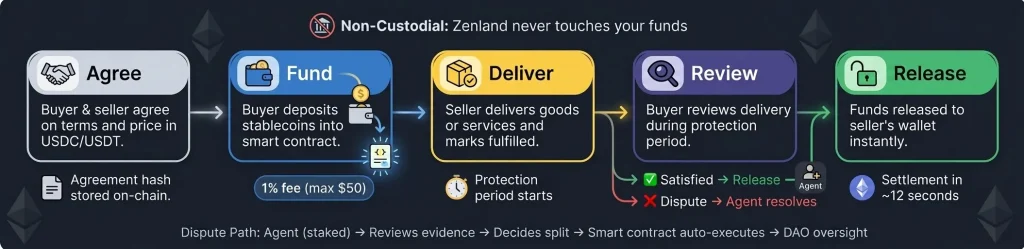
This is where platforms like Zenland operate. The smart contract holds the funds – not the company. The code enforces the rules: time locks, buyer protection periods, seller refund options, and agent-based dispute resolution. Nobody can unilaterally move the funds, and the entire logic is verifiable on-chain.
It combines the security of decentralization with the usability of a platform – the best of both worlds for ethereum escrow services.
Try Non-Custodial Escrow on Zenland →
Is Ethereum Code Safe?
This is one of the most common questions people ask before using an Ethereum escrow service – and it’s a fair one. After all, the history of smart contracts includes some spectacular failures.
The History: Lessons Learned
In 2016, “The DAO” – one of the first major smart contracts on Ethereum – was exploited for $60 million due to a reentrancy bug. It was a watershed moment that led to Ethereum’s hard fork and, ultimately, to much better security practices.
Since then, the ecosystem has matured dramatically:
- OpenZeppelin provides battle-tested, audited contract libraries used by most major protocols
- Formal verification tools can mathematically prove contract correctness
- Security audit firms (Trail of Bits, OpenZeppelin, Consensys Diligence) review contracts before deployment
- Bug bounty programs incentivize white-hat hackers to find vulnerabilities
- Solidity 0.8+ includes built-in overflow protection, eliminating an entire class of bugs
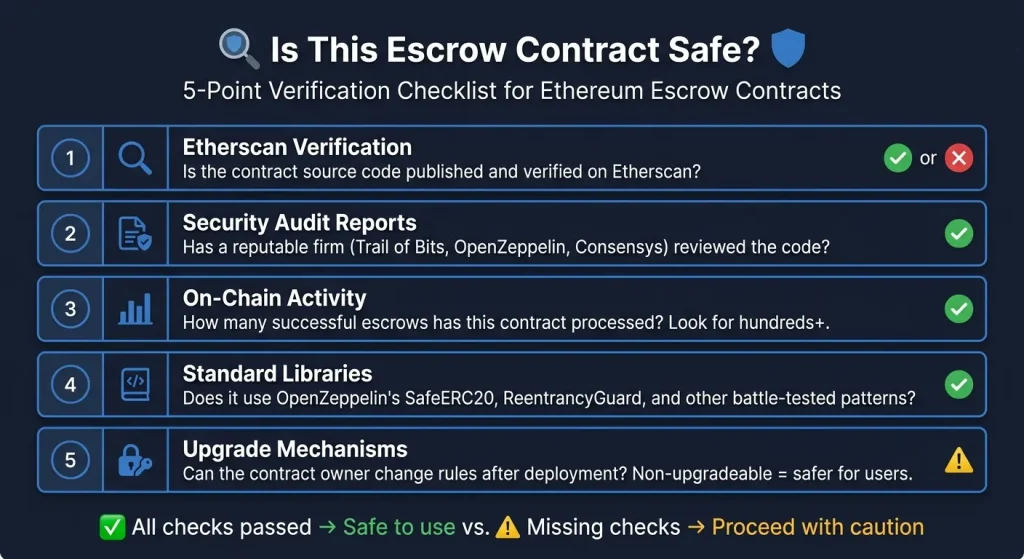
How to Verify an Escrow Contract Is Safe
You don’t need to be a Solidity developer to do basic due diligence. Here’s a practical checklist:
- Check Etherscan verification – Is the contract source code published and verified? If not, walk away.
- Look for audit reports – Has a reputable firm reviewed the code? Are the reports public?
- Review on-chain activity – How many transactions has the contract processed? A contract with hundreds of successful escrows is more trustworthy than a brand-new deployment.
- Check the libraries used – Does it use OpenZeppelin’s SafeERC20, ReentrancyGuard, and other standard patterns?
- Look for upgrade mechanisms – Can the contract owner change the rules after deployment? Non-upgradeable contracts are safer for users.
The bottom line: Ethereum code can be safe – but safety isn’t automatic. It depends on the quality of the code, the rigor of the audits, and the transparency of the team behind it.
USDT vs USDC for Escrow
If stablecoins are the future of Ethereum escrow, which stablecoin should you use? The two dominant options – USDT (Tether) and USDC (Circle) – each have distinct characteristics that matter for escrow transactions.
USDT (Tether)
- Market cap: ~$140 billion – the largest stablecoin by far
- Liquidity: Deepest trading pairs on virtually every exchange
- Availability: Dominant in Asia, LATAM, and emerging markets
- Transparency concerns: Tether has faced ongoing questions about reserve backing, though they now publish quarterly attestations
- Freeze risk: Tether can blacklist addresses and freeze USDT (they’ve done this for law enforcement)
USDC (Circle)
- Market cap: ~$45 billion – second largest, growing steadily
- Regulation: US-regulated, issued by Circle (publicly traded company)
- Transparency: Monthly reserve attestations by Deloitte, fully backed by cash and short-term US Treasuries
- Institutional trust: Preferred by US-based businesses and DeFi protocols
- Freeze risk: Circle can also freeze addresses (same as USDT), but has a clearer legal framework
Which Should You Choose?
| Factor | USDT | USDC |
|---|---|---|
| Liquidity | ✅ Higher globally | Good, but less in some markets |
| Transparency | Improving | ✅ Best-in-class |
| Regulation | Offshore | ✅ US-regulated |
| Availability | ✅ Everywhere | Strong in US/EU |
| For escrow | Great for international deals | ✅ Best for trust-sensitive transactions |
Our recommendation: Both work well for escrow. If transparency and regulatory compliance matter to you (or your counterparty), choose USDC. If you need maximum liquidity or your counterparty is in a market where USDT dominates, go with USDT. The important thing is that you’re using a stablecoin – not volatile crypto.
How Zenland Uses Ethereum Stablecoins
Zenland is built specifically for stablecoin escrow on Ethereum. Here’s how the platform puts everything we’ve discussed into practice:
Supported Tokens
Zenland supports USDC and USDT on Ethereum mainnet. These were chosen deliberately – they’re the most liquid, most trusted stablecoins with the deepest on/off-ramp infrastructure. Additional tokens can be added through DAO governance proposals.
Fee Structure
Zenland charges a flat 1% fee with a $50 maximum cap. This means:
- A $500 escrow costs $5
- A $5,000 escrow costs $50
- A $50,000 escrow costs $50
- A $500,000 escrow still costs $50
Compare that to centralized platforms charging 3-5% with no cap, and the savings on large transactions become enormous. A $100,000 deal on a 3% platform costs $3,000 in fees. On Zenland, it’s $50.
Non-Custodial Architecture
Your stablecoins go directly into the escrow smart contract – not into Zenland’s wallet. The platform never has access to your funds. Even if zen.land went offline tomorrow, your funds would still be accessible through the smart contract on Ethereum.
Dispute Resolution with Staked Agents
When disputes arise, Zenland uses a staked agent system. Agents deposit their own funds as collateral, giving them real skin in the game. They can only arbitrate deals up to their Maximum Arbitratable Value (MAV), and the DAO can slash their stake for unfair decisions. It’s accountability through economics, not trust.
DAO Governance
Zenland’s protocol is governed by a DAO – meaning fee changes, token additions, and protocol upgrades are decided by token holders, not a company. This ensures the platform evolves in the interest of its users, not its shareholders.
Frequently Asked Questions
Can I use ETH instead of stablecoins for escrow?
Technically, some platforms support ETH for escrow. However, we strongly recommend stablecoins for most transactions. ETH’s price can swing 10-20% in a single week, which means the value of your escrow changes during the transaction. Unless both parties explicitly agree to accept volatility risk, stablecoins like USDC or USDT are the safer choice. You’ll still need a small amount of ETH for gas fees regardless of which token you escrow.
What about gas fees on Ethereum?
Gas fees on Ethereum vary with network congestion. For escrow operations, expect to pay roughly $5-20 for creating an escrow and $2-5 for releasing funds (at typical 2026 gas prices). These costs are fixed regardless of the escrow amount – so a $100 escrow and a $100,000 escrow pay the same gas. For very small transactions (under $100), gas fees may not be worth it. For anything above $500, gas is negligible compared to the protection you get.
Is USDT safe for large escrow transactions?
USDT has processed trillions of dollars in volume and maintains its peg consistently. For escrow purposes, it’s reliable. The main risk is regulatory – Tether operates offshore and has faced scrutiny about its reserves. For very large transactions where regulatory clarity matters, USDC (issued by US-regulated Circle) may provide more peace of mind. Both stablecoins carry a theoretical “freeze risk” where the issuer can blacklist addresses, but this has only been done in cases of confirmed fraud or law enforcement requests.
How does Ethereum escrow compare to Bitcoin escrow?
Ethereum escrow is fundamentally more capable. Bitcoin lacks native smart contracts, so Bitcoin escrow relies on multisig wallets with trusted third parties – essentially recreating the traditional escrow model on a blockchain. Ethereum escrow uses programmable smart contracts that can enforce complex conditions automatically: time-based protections, percentage-based dispute splits, staked arbitrators, and more. Add stablecoins to eliminate volatility, and Ethereum escrow is superior in almost every dimension except one: if you specifically need to escrow BTC (not convert it to stablecoins first).
What happens if the Ethereum network is congested?
Network congestion increases gas fees but doesn’t affect the security or functionality of your escrow. Your funds remain safely locked in the smart contract regardless of network conditions. You might pay more gas to create or release an escrow during peak times, but the transaction will still process. If gas prices spike temporarily, you can simply wait for them to come down – your escrow isn’t going anywhere. Layer 2 solutions (like Arbitrum or Base) may offer lower gas fees in the future while maintaining Ethereum’s security.
Can I use Ethereum escrow for international transactions?
Absolutely – this is one of Ethereum escrow’s biggest advantages. Traditional escrow services are often limited by jurisdiction, require KYC from both parties, and can take days to settle across borders. Ethereum escrow with stablecoins is borderless by default. A buyer in Japan and a seller in Brazil can complete an escrow transaction in minutes, with no bank intermediaries, no currency conversion delays, and no jurisdictional complications. The smart contract doesn’t care where you are – it only cares that the conditions are met.
Conclusion: The Future of Escrow Is Ethereum + Stablecoins
The combination of Ethereum’s smart contract capabilities and stablecoin price stability creates the ideal foundation for modern escrow services. It solves every major problem with traditional and Bitcoin-based escrow:
- No volatility risk – Stablecoins maintain consistent value throughout the transaction
- No custodial risk – Smart contracts hold funds, not companies
- No trust required – Code enforces the rules, verifiable by anyone
- No borders – Works globally, settles in seconds
- Fair dispute resolution – Staked agents with economic accountability
Whether you’re a freelancer protecting your next payment, an OTC trader securing a large deal, or a business looking for trustless payment infrastructure – Ethereum stablecoin escrow is the most secure, cost-effective, and transparent option available in 2026.
The question isn’t whether to use escrow. It’s whether you can afford not to.
Create Your First Stablecoin Escrow →
Related Articles:
- What is Crypto Escrow? The Complete Guide for 2026 →
- Smart Contract Escrow: How Blockchain Security Protects Your Funds →
- How to Use Crypto Escrow: Step-by-Step Guide →
Last updated: April 2026